Showing posts with label Music industry. Show all posts

Thursday, March 26, 2015

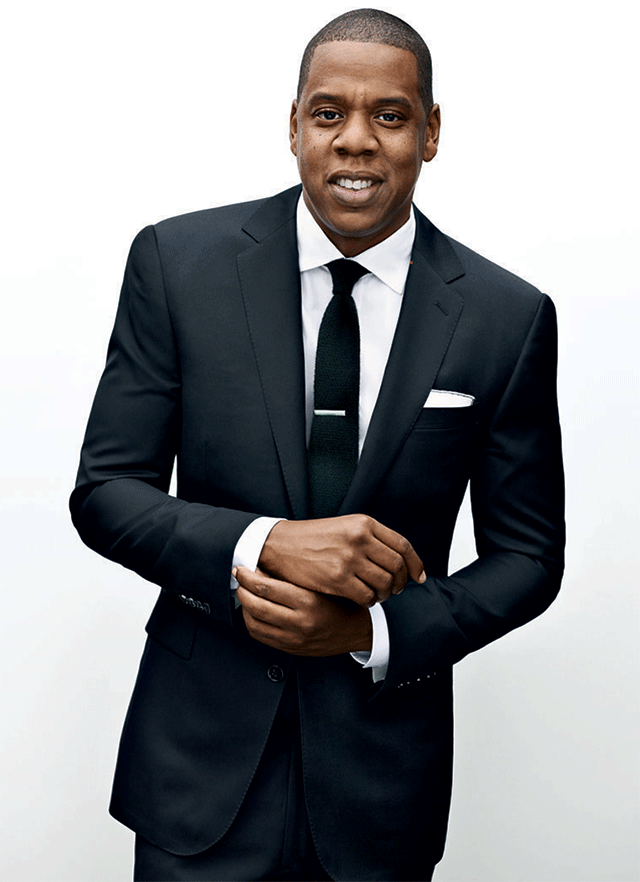
Is Jay-Z the musicians' champion or Universal's heavy hitter?

Lots of intriguing stuff around Jay-Z, Universal, Taylor Swift and others happening recently.  It all began a few weeks ago when one of the Jay-Z's companies bought Aspiro, a Swedish music streaming company that runs the streTidal.  Flashback further and we remember that Taylor Swift removed all her music from Spotify, claiming that it didn't place enough value on music.  There was lots of speculation around why else she may have done this, including rumours that it was an effort to increase sales of her 1989 (which it did) and that her music would appear on Google's new streaming service, Youtube Music Key


This week her back catalogue (her previously recorded music) has turned up on Tidal, which should make the service much more appealing to consumers.  It needs to be given the competition that now exists on the streaming market.  As well as market leader Spotify, we now have Pandora, Youtube Music Key and Apple's soon to re-launch Beats Music.  Tidal is also banking on audiences being drawn to the better quality audio of its service - CD quality, HD sound.  It's monthly subscription is £10 more expensive than Spotify's so the content has to be better.  They seem to be trying offer the audience a more immersive experience as well with music videos and exclusive interviews also available.

What makes this all the more interesting is a big meeting held around the time of the Grammys.  Jay-Z gathered together some of the biggest music artists to discuss a way forward for the music industry.  According to this Forbes article, they may have discussed artists taking control without record labels. It could be that Tidal is a service that would allow artists to do so. The reason artist make so little from services like Spoitify is because the record label takes such a big cut.  Alternatively, he may have just been helping out Universal as all the artists there, bar Madonna, are Universal artists and Jay-Z is also a Universal artists (the label he controls, Roc-a-Fella, is a subsidiary of Universal).  The Forbes article is well worth a read - all two pages!

Wednesday, March 11, 2015

Famous Copyright Cases From The Music Industry

Sky News has usefully compiled a brief summary of some of the most famous musical copyright cases.  Check it out here

How Much Do Artists Make From Spotify?

Time Magazine has created an interesting Spotify earnings calculator where you can see how much major artists earn through being streamed on Spotify.  It's well worth looking at as evidence for the debate over whether streaming is really the future of music distribution. As we know Taylor Swift removed her music from Spotify, claiming that the amount paid doesn't place enough value on her music.  In the past the musician Billy Bragg has claimed that the problem isn't with how much Spotify pays per stream ($0.06 - $0.84 according to Time) but the percentage that the record company takes before the artist gets paid.

Pun Alert: The Blurred Lines Between Inspiration and Copyright Infringement

A court in America made a massive decision in relation to copyright infringement last night.  It ruled that the Robin Thicke and Pharell Williams track 'Blurred Lines' (a Universal release) infringed the copyright of soul legend Marvin Gaye's 'Got To Give It Up'.  Listening to the two tracks, there is a definite similarity in the bass line.  See what you think by listening to the two tracks (below).   This interview has a quite a good explanation of how the ruling raises questions about what counts as inspiration and what counts as infringement.  It also sets out some of the potential problems for musicians as a result of the ruling, including how open they might be about their musical inspirations.
You can read more about the case in this BBC New article.

Of course, the controversy around the message of Blurred Lines is an entirely different matter that deserves a debate of its own.


Saturday, January 03, 2015

Will Competition Make or Break Streaming?

There are some great stats in this article.  With Google and Apple about to launch streaming services, it's interesting to note how none of the existing services make a profit and that very few of the potential users actually pay for the services.  An argument is that the cost of a subscription puts users off paying it and that, with Apple and Google entering the market, the increased competition will force down the price of subscription and encourage more people to sign up and pay for services.  However, what would be the eventual consequence of this?  When prices are forced down some services will inevitably be forced to close because they don't have the scale of business to cope.  This often leads to a near monopoly situation where just the big companies are left and less choice is available to the consumer.  Of course, this could also impact on the artists as one or two companies dominating the streaming market will mean that they can force record labels to accept lower payments per play on the streaming services.  On the flip side of course, this might be the bitter pill that the industry and consumer will have to swallow if they want to see streaming services continue.  Investors will only support Spotify and Pandora for so long before they want to see a profit.

Has technology improved music production?

http://www.thebeatles.com/photo-album/
early-recording-sessions-abbey-road
Theoretically digital technologies can speed up the production process and make it more accessible.  But what effect do they have in practice.  Paul McCartney (for the Kanye West fans amongst you, he's one the last two remaining Beatles) reminds us that the restrictions of the pre-digital era helped to make musicians more focused:

"We would record four tracks in a day - which is unheard of now - and those four tracks still sell more than most contemporary records. So obviously the system was pretty good. It was very simple, you had to just be very disciplined... we knew we had to play great," he said.
"Whereas now you know you go: 'We'll do another take or we'll get it in the mix, we'll just take that bum note out, we'll stick it on Pro-Tools, we'll fix it.' But it gives you, I think, too many options.
"It's great, it's very luxurious, but I don't think it helps the process."
Read more of what he said on the BBC News site.

Monday, November 03, 2014

A Gift From Taylor Swift To You

So you want a neat and tidy argument about new models for making money in the music industry? And you want it all wrapped up in a Universal linked example? Well Taylor Swift (distributed internationally by Universal Music) has duly obliged by removing all her music from Spotify. Read all about it here - http://www.bbc.co.uk/newsbeat/29885973. Within you will find Taylor's arguments about preserving the value of music and, on the opposing side, Spotify's vision of making money from music

Sunday, October 12, 2014

Physical Release of U2's album promises more

You may have wondered why U2 would 'give away' Songs of Innocence for free through the iTunes 'gift'. As TV ads have promised in the last few days, the gift was really just a taster of the physical 'deluxe' release. Buy the deluxe CD and you get a load of tracks not available through the iTunes gift.  This article also has some interesting numbers regarding how many people downloaded the gift version - nearly twice as many as those who have ever downloaded U2 material through iTunes.


Tuesday, September 16, 2014

U2 and Apple - the story that keeps on giving

There's a wealth of stuff available on this story.  This image highlights lots of the issues that can be found in U2's decision to release their new album for free through iTunes.

Sunday, September 14, 2014

iPods have been made obsolete. What of the value of music?

There's a tremendous article in Wired magazine on the end of the iPod, which, as of this week, Apple are no longer selling. It's particularly useful to help you understand how the value of music has changed as technology has changed. Read it here.

Friday, September 05, 2014

Need new Radiohead music? There's an app for that.


Having released a whole album via their website a few years ago, Radiohead have now used their app to give fans a chance to hear their first new music in three years. Another example of how digital technology is fundamentally changing the distribution and promotion of music. Read this article to find out more, including interactive features that are built into the listening experience.

Tuesday, January 28, 2014

The Crippling Power of a Record Company - Can the Artist Fight back?

Azealia Banks has used Twitter to voice her dissatisfaction with Universal Music. She's actively looking to leave her label Interscope (owned by Universal) -read about it here and here .  However, can't because she's contracted to them.  So what's an artist to do when they are so clearly 'owned' by a label.  All that's left to them is to go public with their complaint - as Prince and George Michael have done in the past.  Twitter and social media make it easier for the artist to do this - no elaborate change of name (ala Prince) needed to get global attention for your grievance.   It's also interesting that she complains about the supposed out of touch nature of those at Universal who make decisions about her music and career.  It seems she has previous on this, having made similar complaints about her time at XL (part of the Beggars Group).

Thursday, January 02, 2014

Easy Listening on the Music Industry

BBC Radio 4 just broadcast a great half hour on the present and future of the music industry, featuring both Billy Bragg and Moby (discussed in class).  It will be broadcast again on Sunday night.  Find out more here.

What have we learnt from living with digital technology?

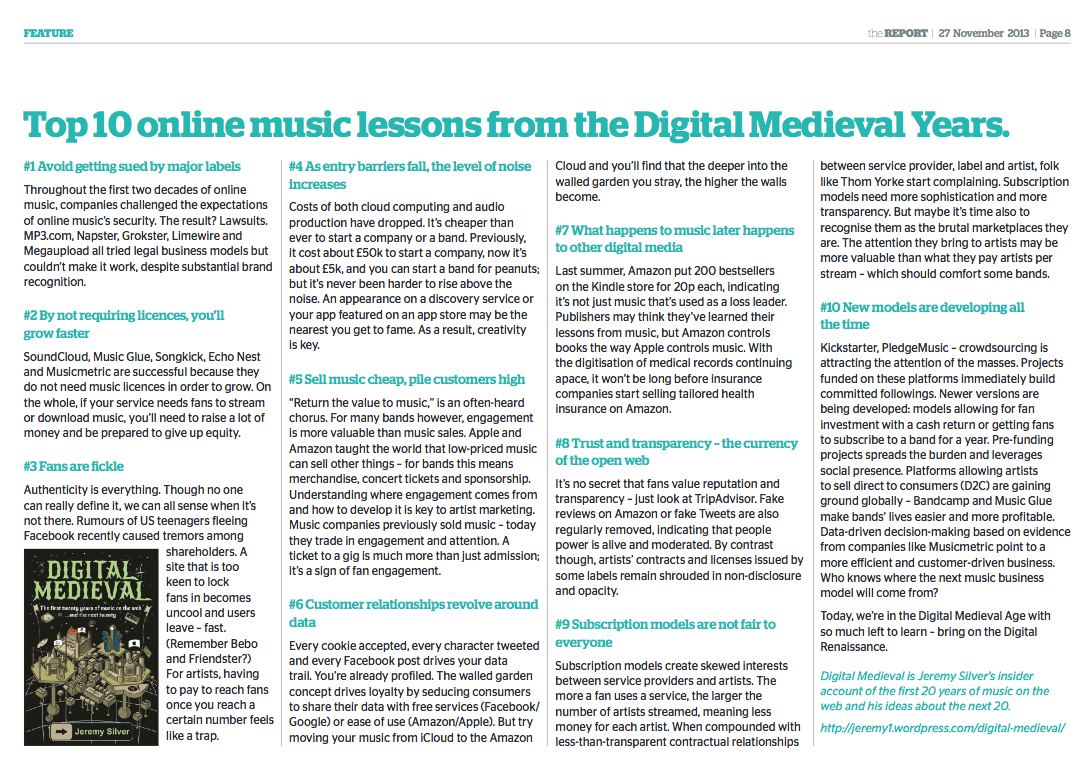
Jeremy Silver is the author of Digital Medieval, a book that traces the music industry's response to the growth of and impact of digital technologies.  Go here to read his Top 10 lessons of the recent digital years.

Tuesday, December 10, 2013

6 Digital Devices Per Teenager = A Very Different Future

http://t.co/yyTcDNZfWt A report in on the BBC news site yesterday says the average teenager now owns 6 digital devices and anticipates that soon teenagers will view "always on connectivity" as a right - a bit like those of you who seem to have your smartphone tattooed to your inside wrist. 

The question this kind if ownership and access throws up is, what's the impact of this on the music industry. Will this finally signal the end of the CD and cement the power of Spotify? Will it increase the sharing of music or will it lead us further down our personalised cul de sacs of taste? Answers on an exam booklet please.

Wednesday, November 06, 2013

Are Spotify the new Gatekeepers in the Music Industry?

There was a brief moment a few years ago when digital technology promised to get rid of record companies and allow artists to directly reach out to audiences.  The band Radiohead were pioneers in doing this when they released their In Rainbows album digitally through their website.  They invited the audience to download it and pay as much as they thought it was worth.  The great hope at the time was that role of the record company as the "gatekeeper" between artist and audience would gradually disappear as digital production and distribution made everything more affordable and accessible and dispensed with the need the record company.

The idea of the 'gatekeeper' is a vital one.  It is the gatekeeper who controls who goes in and who goes out - what artists get signed, when and how the public get to hear about them and how the artist interacts with their audience. Think about the debate sparked by Sinead O'Connor about Miley Cyrus's image and who is responsible for it.  This was added to recently when Charlotte Church spoke out about record company execs convincing her that in order for her to sell to an audience, she would need a more sexualised image. Gabriella Cilmi talks about a similar experience in today's Metro.  The gatekeeper, here, is a very powerful figure and Thom Yorke from Radiohead has recently argued that instead of the record companies, the gatekeeper role is now being taken up by streaming services such as Spotify.  Because Spotify have become so dominant, they have greater control whether your music is heard or not.  If the mass audience are using Spotify to access new music, it makes it much more difficult for artists who are not on the service to get heard.  Read more by clicking on all the links - the more you read, the more case study material you have for the exam.

For those of you unfamiliar with Radiohead, check this out.

Streaming - and the debate goes on.

You've read what David Byrne had to say about the effect of streaming services on artists and creativity - your homework this week in case you needed reminding.  This article about musicians in Sweden suing record labels has a ton of facts and figures that can be used in the exam.  The musicians claim that the labels aren't giving them a big enough cut of money made through streaming services.  Depending on your record contract, an artist could be in a position where they make £500 compared to the record companies £4,500 from 1 million plays of their music on a streaming service, e.g. Spotify.  On Facebook, the musician and activist Billy Bragg, has argued that musician's shouldn't complain about the streaming services but try to negotiate better contracts with the record companies.

If you haven't heard of Billy Bragg before, check this out.

Excellent Music Industry Resource

Helienne Lindvall is a songwriter and musician who regularly writes for the Guardian about matters related to the music industry. I occasionally post links to some of her articles here but if you follow this link you can access all that she's written for the Guardian in the past. These are an excellent resource if you want to understand the issues from an artist's point of view.