Sometimes, when grappling with the thorny issues of ownership, synergy and technological convergence, you just need to listen to great music. It helps to clear the mind.
Tuesday, January 28, 2014


The Crippling Power of a Record Company - Can the Artist Fight back?
Azealia Banks has used Twitter to voice her dissatisfaction with Universal Music. She's actively looking to leave her label Interscope (owned by Universal) -read about it here and here . However, can't because she's contracted to them. So what's an artist to do when they are so clearly 'owned' by a label. All that's left to them is to go public with their complaint - as Prince and George Michael have done in the past. Twitter and social media make it easier for the artist to do this - no elaborate change of name (ala Prince) needed to get global attention for your grievance. It's also interesting that she complains about the supposed out of touch nature of those at Universal who make decisions about her music and career. It seems she has previous on this, having made similar complaints about her time at XL (part of the Beggars Group).
Wednesday, January 22, 2014
Lighting Tips
A quite exhaustive guide to different types of lights. Towards the end he gives some useful tips on using cheap every day lights to improve your shots.
Thursday, January 02, 2014
Easy Listening on the Music Industry
 BBC Radio 4 just broadcast a great half hour on the present and future of the music industry, featuring both Billy Bragg and Moby (discussed in class). It will be broadcast again on Sunday night. Find out more here.
What have we learnt from living with digital technology?
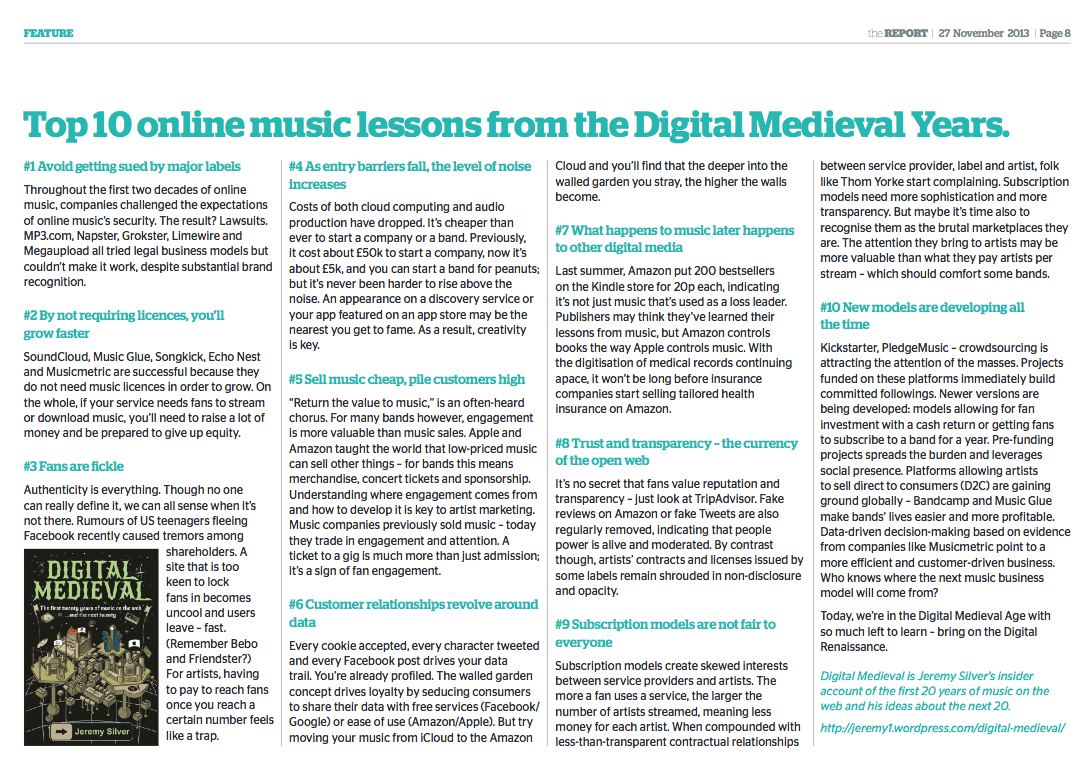
 Jeremy Silver is the author of Digital Medieval, a book that traces the music industry's response to the growth of and impact of digital technologies. Go here to read his Top 10 lessons of the recent digital years.
Tuesday, December 10, 2013
6 Digital Devices Per Teenager = A Very Different Future
http://t.co/yyTcDNZfWt A report in on the BBC news site yesterday says the average teenager now owns 6 digital devices and anticipates that soon teenagers will view "always on connectivity" as a right - a bit like those of you who seem to have your smartphone tattooed to your inside wrist.
The question this kind if ownership and access throws up is, what's the impact of this on the music industry. Will this finally signal the end of the CD and cement the power of Spotify? Will it increase the sharing of music or will it lead us further down our personalised cul de sacs of taste? Answers on an exam booklet please.
Wednesday, November 06, 2013
Are Spotify the new Gatekeepers in the Music Industry?

The idea of the 'gatekeeper' is a vital one. It is the gatekeeper who controls who goes in and who goes out - what artists get signed, when and how the public get to hear about them and how the artist interacts with their audience. Think about the debate sparked by Sinead O'Connor about Miley Cyrus's image and who is responsible for it. This was added to recently when Charlotte Church spoke out about record company execs convincing her that in order for her to sell to an audience, she would need a more sexualised image. Gabriella Cilmi talks about a similar experience in today's Metro. The gatekeeper, here, is a very powerful figure and Thom Yorke from Radiohead has recently argued that instead of the record companies, the gatekeeper role is now being taken up by streaming services such as Spotify. Because Spotify have become so dominant, they have greater control whether your music is heard or not. If the mass audience are using Spotify to access new music, it makes it much more difficult for artists who are not on the service to get heard. Read more by clicking on all the links - the more you read, the more case study material you have for the exam.
For those of you unfamiliar with Radiohead, check this out.
Subscribe to:
Posts (Atom)